
How Much Does a Ménage Cost in Cornwall? What Sets the Price
How Much Does a Ménage Cost?
The cost of a ménage is set by seven things: its size, the slope and ground of the site, the drainage, the depth of the stone base, the surface, the fencing and edging, and the access for machinery and deliveries. Planning permission adds its own cost and time where it is needed.
That is why an arena is priced from the ground itself, never from a list. Two sand schools of the same size can cost very different amounts if one sits on level, free-draining land beside the yard and the other is cut into a wet, sloping field down a narrow lane.
The base and drainage carry most of the groundwork, and they decide how the arena rides for years. A free site visit and a written quote give you the true figure for your site.
What Drives the Cost of a Ménage
Size. The footprint sets the area to strip, level, drain and surface, so every other cost scales with it. A larger arena means more stone, more surface and more fencing.
Slope and levels. An arena must be level, or very close to it. On a sloping field the ground has to be cut and filled to create a flat platform, and the steeper the slope, the more earth moves and the larger any bank or retaining edge becomes.
Ground conditions. West Cornwall ground varies field by field. Granite across Penwith and serpentine on The Lizard can mean breaking out rock, clay holds water and needs more drainage, and sandy ground around Hayle drains freely but needs a firm, well-compacted formation.
Spoil. Topsoil and excavated material either stay on site, reshaped into banks or used elsewhere on the land, or leave site as muck away, which we can arrange as part of the job.
Access. A wide gateway close to the site keeps machinery and stone lorries moving. A long or narrow approach can mean a temporary track first.
The Base and Drainage: Where an Arena Is Won or Lost
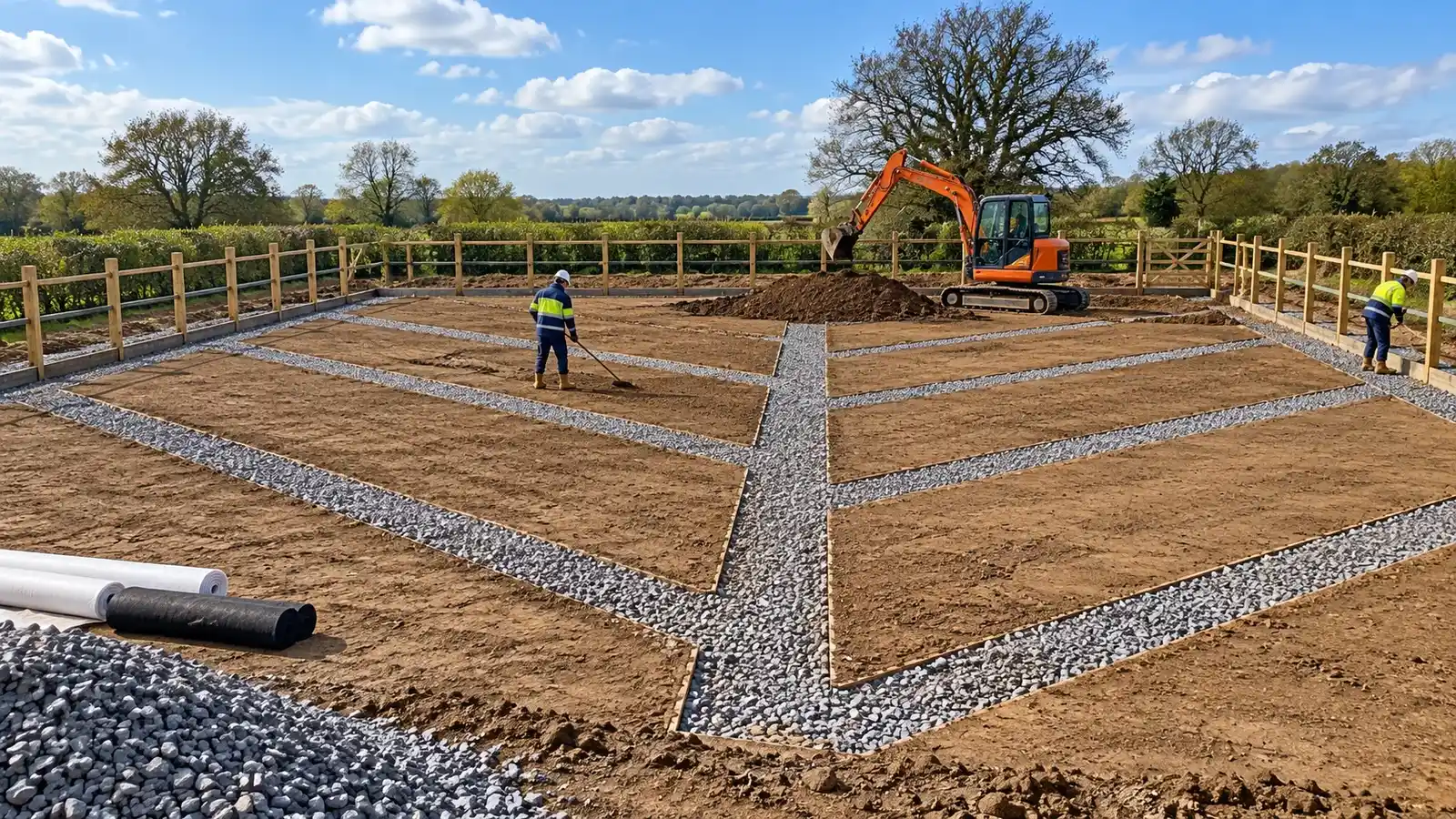
A ménage lives or dies on what sits underneath it. The surface is the part you ride on, but the drainage layer and the sub-base decide whether it stays level, firm and usable through a Cornish winter.
A typical build runs in stages. The topsoil is stripped and the formation cut level. Drainage runs are dug across the base, laid with perforated pipe and filled with clean stone, so water leaving the surface has somewhere to go. A membrane separates the ground from the stone above it, and a compacted stone base is built up in layers, shaped and trimmed to receive the surface. Edging and kickboards then hold the surface in place.
Each layer adds cost, and each one protects the investment above it. The depth of stone, the spacing of the drains and where the water finally discharges are all designed to your ground.
This is the work our horse arena construction team carries out on our own machinery, from the first dig to the finished base.
Planning, Surfaces and Fencing: The Costs People Forget
Planning permission. A ménage on land not already in equestrian use usually needs planning permission. Councils commonly condition the surface, drainage, fencing and lighting, so those conditions shape the specification and the budget. Check the position with Cornwall Council before you commit to a design.
The surface. Arena surfaces vary widely in material and depth, and the right one depends on how you ride and how often. Whichever you choose, its performance depends on the base and drainage beneath it, and the cost depends on the material, the depth and the area it covers.
Fencing, gates and edging. Timber post and rail around the perimeter, a gate wide enough for a tractor to maintain the surface, and kickboards to keep the surface in place all belong in the budget from the start. Our fencing service covers arenas and paddocks.
Lighting and access. Floodlights, power to the site and a firm approach track from the yard are easy to overlook, and simpler to plan in at the beginning than to add later.
When to Call a Specialist Arena Contractor
Call when you have a site in mind and a rough idea of the size you need, ideally before the planning application is drawn up. A site visit at that stage settles the levels, the drainage route and the access while the design can still change. Our horse arena construction service covers the earthworks, drainage, stone base and edging, carried out by our own team on our own machinery, with a written quote before anything starts.
Ménage Cost Questions
How much does it cost to build a ménage?
How can I keep the cost of a horse arena down?
How much do arena surfaces cost?
Is a 20 by 40 arena big enough?
Plan Your Ménage With a Specialist Contractor
Tell us where your arena will go and how you ride, and we will walk the ground with you. You get a free site visit and a written quote that sets out the work, the specification and the price before anything starts.
Call Ross on 07460 077745·Book a free site visit online
Based in Hayle, working across West Cornwall
Phone: 07460 077745
Email: office@lunamaintenanceltd.com
Hours: 7am to 7pm, 7 days a week