
French Drains in Cornwall: How They Work and When You Need One
What Is a French Drain?
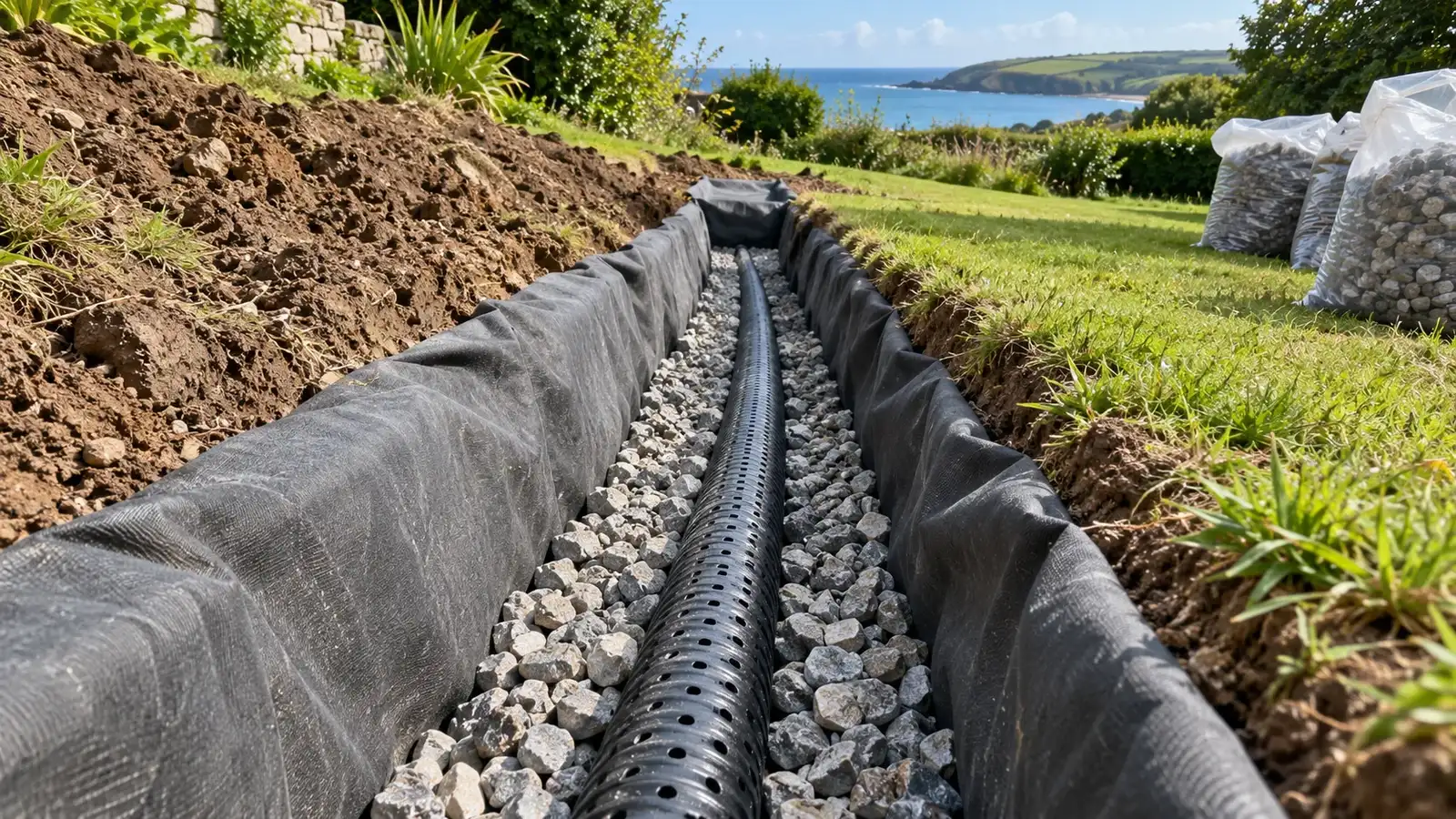
A french drain is a trench filled with clean stone, usually with a perforated pipe running along its base, that collects water from the surrounding ground and carries it away to a safe outlet. Water finds the easiest route through the soil, and the stone-filled trench gives it one.
Do you need one? A french drain is the right answer when water is collecting in the ground and needs to be moved somewhere else: a waterlogged lawn, a slope that sends water towards the house, damp ground behind a wall, or a wet gateway or yard edge on a farm.
It is not a cure-all. A french drain only works with a fall along its length and an outlet that can take the water, so both are designed before the first dig.
How a French Drain Works
A french drain is simple in principle and exact in the details. Each part has a job.
The trench. It is dug along the line where water collects or needs intercepting, to a depth that suits the ground and the problem being solved. The base of the trench is set to a steady fall, so water always moves towards the outlet.
The membrane. A geotextile membrane lines the trench. It lets water through but keeps fine soil out of the stone, which is what stops a french drain silting up over time.
The stone and pipe. A layer of clean, washed stone goes in first, then the perforated pipe, laid to the fall, then more stone above it. Water seeps into the stone, enters the pipe through its perforations and runs to the outlet.
The finish. The membrane is folded over the top of the stone, and the trench is finished with more stone or with topsoil, depending on where it runs.
Our own french drain work follows exactly this build: membrane, clean stone and perforated pipe, laid by our own team.
Where French Drains Earn Their Place in Cornwall
Gardens and sloping plots. On a sloping site, a french drain across the slope catches water before it reaches the house or a patio. That suits the steep plots common around Carbis Bay and St Ives.
Behind retaining walls. Water building up behind a wall puts pressure on it. A drain at the back of a retaining wall relieves that pressure and carries the water away.
Alongside driveways and patios. Where a hard surface sheds water onto lawn or a border that cannot take it, a french drain along the edge collects it.
Farms and paddocks. Wet gateways, yard edges and the perimeter of an arena all benefit from ground that drains. On a farm this often forms part of wider agricultural groundworks.
The ground itself. West Cornwall ground behaves differently from place to place. Clay holds water, so it is where french drains are needed most, granite can leave water perched on rock just below the surface, and sandy ground around Hayle drains freely on its own.
Our drainage services cover french drains alongside soakaways, septic tanks and land drainage for wet paddocks and yards.
Getting the Water Away: Outfalls, Soakaways and the Rules
A french drain moves water. Where it sends that water matters just as much as the drain itself.
The order of preference. Building Regulations Approved Document H sets out where rainwater should go: into the ground through a soakaway first, then to a watercourse such as a ditch or stream, and only then to a sewer. A connection to a public sewer needs the agreement of the water company.
Soakaways. A soakaway is a pit or crate system that stores water and lets it soak into the surrounding ground. It only works where the ground can absorb water, so the ground's ability to drain is tested first. Heavy clay or shallow rock may rule one out.
The highway. Under section 163 of the Highways Act 1980, surface water must not be allowed to flow from private land onto a public road. A drain that empties at the roadside is not a solution.
Septic tanks. Rainwater belongs in a soakaway or a surface water system, never in a septic tank, which is designed for foul water only.
Getting the outfall right at the design stage is what makes the drain work for years.
When to Call a Drainage Contractor
Call when water is standing where it should not, when a slope sends water towards your house, or when you are planning a patio, driveway or wall and want the drainage designed in from the start. A site visit looks at where the water comes from, the fall available and where it can lawfully go. Our drainage team installs french drains and soakaways with our own machinery, with a free written quote before anything starts.
French Drain Questions
What is a french drain?
Do I need one?
French drain or soakaway?
Where can the water legally go?
Talk to a West Cornwall Drainage Contractor
Tell us where the water is collecting and we will come and look at the ground with you. You get a free site visit and a written quote that sets out the work, the specification and the price before anything starts.
Call Ross on 07460 077745·Book a free site visit online
Based in Hayle, working across West Cornwall
Phone: 07460 077745
Email: office@lunamaintenanceltd.com
Hours: 7am to 7pm, 7 days a week